
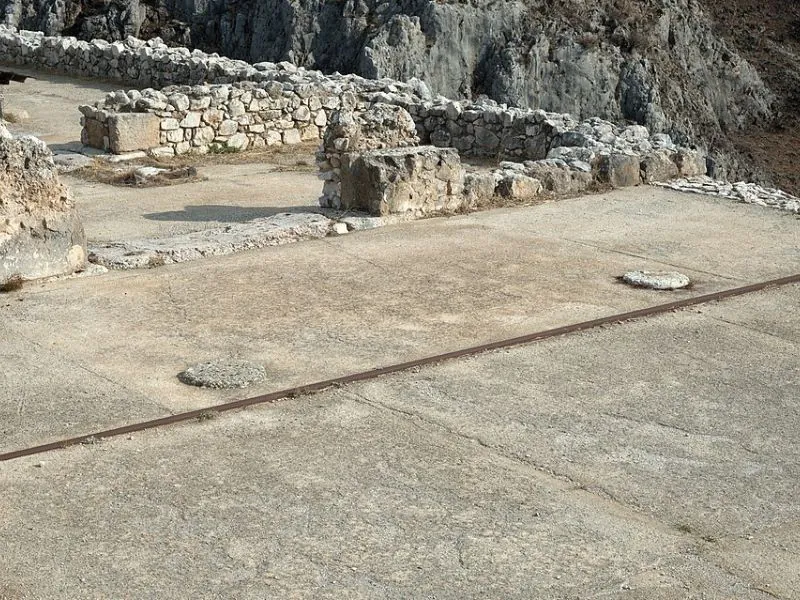
Climb the ramp from the Lion Gate, follow the zig-zag path past storerooms and workshops, and you reach the summit of the citadel where the Megaron of Mycenae once blazed with hearth-fire and royal authority.
More than an architectural curiosity, this rectangular hall was courtroom, temple and banqueting suite rolled into one. Understanding it unlocks how Mycenaean kings ruled, worshipped and even cooked dinner—and why later Greeks turned its floor-plan into the blueprint for their earliest temples.
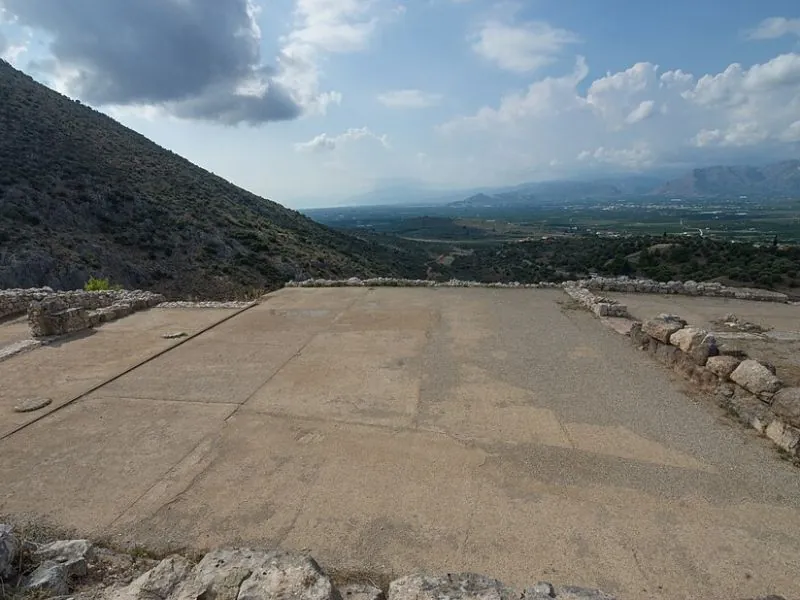
Rectangular rather than square, the hall’s entrance was on its short east wall, emphasising depth over width—a “long-room” plan typical of early Greek design. Visitors passed a two-column portico into a vestibule (pro-naos) and then the main chamber (naos) where:
Massive Cyclopean foundations keyed the building into the surrounding palace terraces, yet the superstructure—mud-brick on a stone socle—was surprisingly light, evidence of the “wattle-and-daub” and pisé techniques attested across Aegean sites.
Fire was both light source and cult focus. Libations of wine and oil were poured directly onto the flames before councils or feast days; greasy residues still stain the hearth’s plaster rim. Scholars link this to a wider Indo-European concept of the king as keeper of an “eternal” household fire that guaranteed divine favour.
Processions led from the Lion Gate, up the Great Ramp and straight through the portico—architectural choreography guiding guests from public space to sacred centre. No wonder Linear B tablets reserve the word wa-na-ka-te-ro (“belonging to the wanax/king”) for the megaron precinct.

The Megaron of Mycenae doubled as throne-room and ministry. Side chambers stored seal-stone archives; tablets record allocations of oil, textiles and bronze to palace workshops.
During audiences the king sat on a wooden throne overlaid with painted stucco, while rows of portable stools accommodated councillors along the walls. Archaeologists recovered bits of imported glass and faïence—elite gifts that emphasised Mycenae’s Mediterranean reach.
Adjoining the main hall lay a second, slightly smaller long-room, traditionally called the “Queen’s Megaron” or gynaikonitis.
Here loom-weights, whorls and traces of purple dye reveal intensive textile production—high-value goods managed by palace women and priestesses. Nearby pantry rooms held pithoi for wine, oil and perfumed unguents, turning the complex into both ceremonial hub and working household.
Minoan influence is clear in the tapering wooden columns and marine motifs, yet the megaron left an even bigger legacy: its three-part layout (porch, vestibule, cella) reappears, in stone, as the ground-plan of Archaic Doric temples—right down to columned façades and axial doorways.
Stand atop the citadel and you are looking at the ancestor of the Parthenon in conceptual form.
Sometime around 1200 BCE a fierce blaze charred columns, vitrified plaster and tumbled roof beams—part of the wider “Bronze-Age Collapse”. The burnt layer sealed valuable clues, including a fragmentary red sandstone abacus from the porch, still blackened at the edges, proving how hot the fire burned.
Heinrich Schliemann cleared the room’s outline in the 1870s; later excavators retrieved fresco fragments and throne revetments, now displayed in the Nafplio Archaeological Museum.
More than three millennia later the Megaron of Mycenae still anchors our understanding of Aegean palace life. Its long-room plan shaped Greek temples; its hearth rituals illuminate Homeric poetry; its administrative tablets show a bureaucracy as complex as any Renaissance court.
Stand within its foundations and you straddle the moment when domestic hall, royal palace and sacred precinct first fused—an architectural idea that echoed from Bronze-Age Argolis to the marble facades of classical Greece.